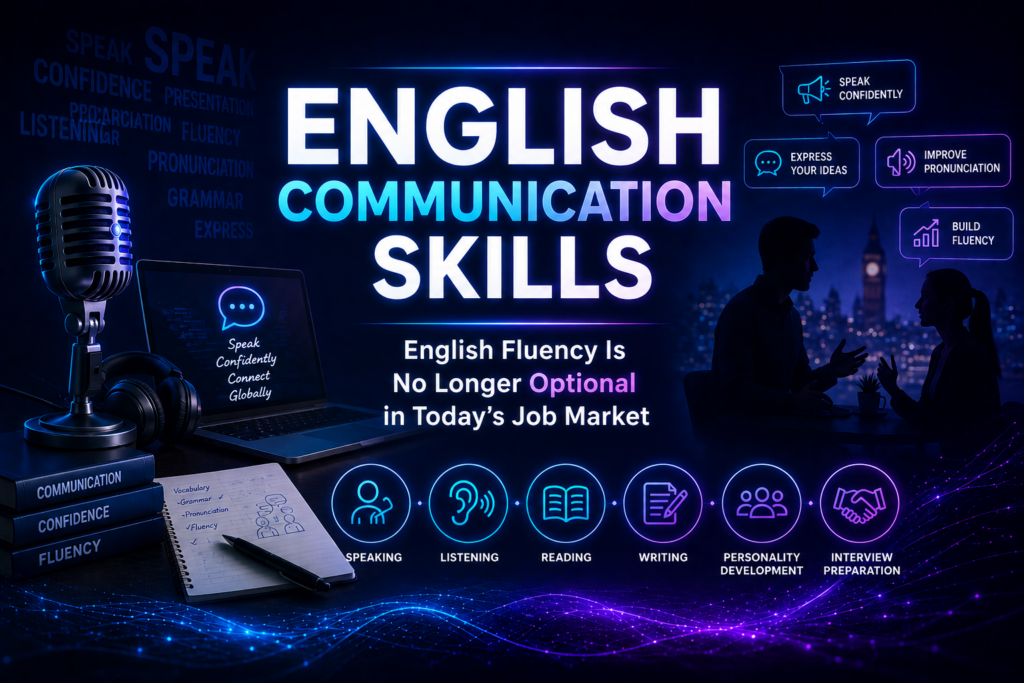
Two candidates walk into the same interview with the same qualifications on paper. One gets the offer. The difference, more often than recruiters admit, comes down to how each one communicates in English. This guide looks at why that gap has grown wider in 2026, what a structured spoken English course actually needs to cover, and how the Spoken and Communicative English programme at Tally Institute of Learning – Baguiati builds that skill from the ground up.
In this guide:
- Why English fluency matters more in 2026
- What a Spoken and Communicative English course teaches
- Beginner Level: building the foundation
- Intermediate Level: speaking with confidence
- Why offline, live practice works better for speaking
- How fluency changes what happens in an interview and at work
- Tips to get more from any spoken English course
- Where to learn spoken English in Kolkata
- Frequently asked questions
Why English Fluency Matters More in 2026
India’s job market improved on paper in 2026. The India Skills Report, put together by ETS along with CII, AICTE, AIU and the hiring platform Taggd, put national employability at 56.35%, up from 54.81% the year before. Read past the headline number, though, and the same report keeps flagging one gap that hasn’t closed: weak communication and professional English, especially among first-generation learners entering the workforce.
The Mercer-Mettl India Graduate Skill Index tells a similar story. Only 42.6% of Indian graduates test as job-ready, down slightly from 2023, and the steepest drops sit in roles that depend on communication rather than pure technical output. A candidate can clear every technical round and still lose the offer in the HR interview, simply because the panel struggles to follow how they explain their own work.
None of this is about intelligence. A candidate who reasons clearly in Bengali or Hindi reasons equally clearly in English once they’ve had structured practice speaking it, rather than only studying its grammar on paper.
What a Spoken and Communicative English Course Teaches
At Tally Institute of Learning – Baguiati, the Spoken and Communicative English programme runs offline over six months, two classes a week, two hours a class. It’s split into two levels: Beginner Level (BL) and Intermediate Level (IL), 24 classes each, 48 hours per level.
Both levels end with an in-house certificate. The institute itself is ISO 9001:2015 certified, which speaks to how the course structure, assessment and delivery get documented and reviewed, beyond how the classroom feels on any given day.
Beginner Level: Building the Foundation
The Beginner Level assumes no prior comfort with spoken English and builds it in six stages.
Module 1, Getting Started with English (Classes 1 to 4), opens with English sounds, greetings and self-introductions, then moves into family vocabulary and describing a daily routine in the present tense.
Module 2, My World (Classes 5 to 8), covers food, directions, clothing and describing people, the vocabulary a beginner reaches for constantly in daily life.
Module 3, Everyday English (Classes 9 to 12), works through shopping conversations, talking about hobbies, asking for travel information and describing the weather.
Module 4, Express Yourself (Classes 13 to 16), introduces present continuous and simple past tense alongside talking about emotions and festivals, the point where students start narrating rather than only naming things.
Module 5, English for Real Life (Classes 17 to 20), moves into future tense, workplace vocabulary, writing a WhatsApp or social media post with the right tone, and drafting short emails.
Module 6, Step Up and Speak Up (Classes 21 to 24), closes with revision, a group debate, a project presentation and a final written and oral exam covering all four language skills.
Each module includes a small hands-on project: a five-sentence English diary, a family show-and-tell, a one-minute recorded video, a short written message. The syllabus leans on bilingual scaffolding early on, using Bengali or Hindi alongside English, and drops that support gradually as students gain confidence.
Intermediate Level: Speaking With Confidence
The Intermediate Level assumes a working foundation and pushes it toward fluency.
The first stretch of classes reviews present, past and future tenses through daily conversation rather than worksheets, then builds into practical vocabulary: home and family, phone conversations, shopping, directions, and describing people and places. A mid-course assessment around Class 12 checks what’s held and what needs more work before the second half begins.
The second half moves into higher-stakes speaking situations: ordering in a restaurant, discussing travel, talking through a health concern, distinguishing simple past from present perfect, and workplace communication. The final stretch covers public speaking, group discussions, common grammar errors, small talk, storytelling and everyday idioms, closing with a course review and final assessment.
By the end of both levels, a student has moved from basic greetings to holding a workplace conversation, handling a group discussion and giving a short presentation, the exact situations a real interview panel or a first week on the job tends to throw at someone.
Why Offline, Live Practice Works Better for Speaking
Plenty of skills transfer well to a screen. Speaking fluently in front of another person doesn’t, not as easily.
A live classroom catches a mispronounced word the moment it happens and corrects it before it becomes a habit. Roleplay only works with a real partner responding in real time, not a script running on a delay. And the mild social pressure of speaking up in front of classmates, getting it wrong, and trying again anyway, is part of what builds the confidence a course is meant to deliver in the first place.
That’s the reasoning behind running the Spoken and Communicative English programme offline: two hours, twice a week, face to face, for six months straight.
How Fluency Changes What Happens in an Interview and at Work
Fluency changes an interview before a single technical question gets asked. A confident, clear self-introduction sets the tone for everything that follows, and a panel that has to strain to follow an answer forms an impression long before it finishes evaluating the content of that answer.
At work, the effect compounds. A colleague who explains a problem clearly in a meeting gets heard before someone who says the same thing haltingly, even when the second person understood the problem equally well. A short, professional email lands differently once the tone and grammar don’t get in its own way. Handling a client call without hesitating is often the difference between getting trusted with the next one and getting quietly reassigned.
None of this replaces technical skill. It decides how much of that technical skill gets seen and credited.
Tips to Get More From Any Spoken English Course
- Speak English for at least 30 minutes daily, with a classmate, a family member, or alone in front of a mirror if nobody’s around.
- Watch English shows with English subtitles instead of Hindi or Bengali ones. The mismatch between subtitle language and speech is what trains the ear.
- Record a one-minute answer to a common interview question, then listen back. Most people catch their own filler words and mispronunciations faster by ear than by correction.
- Learn new words inside full sentences, not as isolated vocabulary lists. A word learned in context sticks longer than one memorised alone.
Where to Learn Spoken English in Kolkata
A course that combines structured grammar, live pronunciation correction, roleplay and real assessment gets a student further than self-study alone, especially for anyone who has tried apps or YouTube videos and stalled at the same plateau.
The Spoken and Communicative English programme at Tally Institute of Learning – Baguiati runs both levels offline, over six months, with an in-house certificate at the end and the institute’s ISO 9001:2015 certification behind the course structure itself.
Frequently Asked Questions
What does the Spoken and Communicative English course at Tally Institute of Learning – Baguiati cover?
Two levels, Beginner and Intermediate, 24 classes each at 2 hours a class. The Beginner Level builds grammar, vocabulary and confidence from the basics. The Intermediate Level pushes toward workplace conversation, public speaking, group discussion and interview-level fluency.
How long does the course take?
Six months, offline, two classes a week at two hours each, covering both levels.
Is a certificate provided?
Yes, an in-house certificate on completion. Tally Institute of Learning – Baguiati is ISO 9001:2015 certified.
Is prior English knowledge required to join?
No. The Beginner Level assumes no prior comfort with spoken English and starts from basic sounds, greetings and self-introductions.
Why does English fluency matter for jobs in 2026?
Because employer surveys keep reporting it as a gap even as technical skills improve. The India Skills Report 2026 and the Mercer-Mettl India Graduate Skill Index both point to communication, not technical ability alone, as what holds otherwise qualified candidates back in interviews and early career roles.
Have Questions? Get in Touch
Speak to our counsellors or browse our full course catalogue.